28 August 2005

Some more L. vibrans, and a Panamanian damsel

For the first time in weeks, Stylurus and I went out to look for odes this weekend. It's Aeshna season, yet we saw not a single one. We did find his namesake fairly readily -- Arrow Clubtails, Stylurus spiniceps, were patrolling the Huron River. We spent some time looking for the state-threatened Russet-tipped Clubtail, Stylurus plagiatus, a species I discovered in the county five years or so ago. I've only found them on one stretch of the Huron, and they can usually be located perched in the surrounding vegetation. A thorough beating of the bushes did not yield any; we did have a tentative sighting on the river, but the lighting wasn't the best.

We returned to a couple of the spots I'd discovered on my bike earlier this summer. They were much drier, allowing further exploration. We were able to get right next to a mucky shallow pond in the woods, adjacent to the Huron, and were rewarded with the sight of at least three male Great Blue Skimmers, a species we'd only just confirmed for the state in July. We took one voucher for this new site, and I didn't even fall in the stinky mud.


Meanwhile, I've been working through the identifications of odonata I photographed on my recent tropical trip, a task that could not be accomplished without the expert opinions of Dennis Paulson, Nick Donnelly, and Sid Dunkle. One of the cooler damselflies I saw was an Acanthagrion, or wedgetail. The Mexican Wedgetail (Acanthagrion quadratum) occurs in the southwestern U.S., but I've never seen one. This photo is likely A. trilobatum. You can see how they got their name. I'll post a list of positively ID'd species soon, as well as more photos. I'll be providing my photos to Paulson's Odonata Biodiversity web pages, which were a great resource for me.

20 August 2005

Helicopter Damselfies

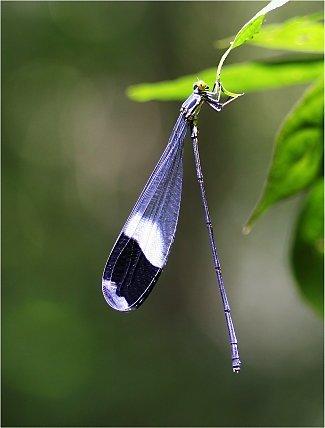
Dragonflies of the World by Jill Silsby is ode porn. Not only is it full of great information on odonata biology, it offers a tantalizing overview of the world's odonata. From the time I first looked through its pages, many families and species quickly ascended to the top of my "must see" list. One such family was the Pseudostigmatidae, or Forest Giants. The largest living odonate in the world, Megaloprepus caerulatus (wingspan of about 7 inches) is in this family, which is found in Latin American rainforests. Despite their size, pseudostigmatids are rather delicate looking, sort of like extremely elongated spreadwings (Lestes).

Another common name for this group is helicopter damselflies. Pseudostigmatids have very large spots at their wing tips, sometimes replacing the pterostigmas. When they fly -- quite slowly -- they really resemble helicopters! They also have a very specialized mode of foraging: they hover in front of spiderwebs and pluck out the spiders, preferring soft-bodied arachnids to hard-bodied ones. Although they look ungainly, they are skillful at manuevering close to the web to grab the spider, and then going in reverse to back away without getting entanged in the web.

This female (left) is in the genus Pseudostigma; according to a checklist by T.W. Donnelly it should be P. accedens. The other species is P. aberrans, a good match for this photo. A key to the Costa Rican species notes that accedens is rarely found in Panama, so it's a toss-up. This photo was taken at the Metropolitan Nature Park in Panama City. UPDATE: Both Donnelly and Dennis Paulson have identified this as most likely Mecistogaster ornata.

Pseudostigmatidae breed in standing water in tree holes. Males will defend good breeding sites. Little sunny openings at stream crossings are also good places for spiders. Consequently, we were able to find Megaloprepus caerulatus in many such locations. Although the largest odonate in the world, individuals vary greatly in size. Some seemed truly huge, others, just big.

The one on the right allowed us to take many photos as he explored leaf tips looking for spiders. The second photo, below, isn't great, but shows that the black spot on the wings is actually metallic blue. When they land, helicopter damsels fold their wings slowly, it looks really cool! This individual was photographed outside of Gamboa, Panama, along the Rio Chico Masambi.


A web site on the odonata of La Selva, in Costa Rica, has photos of specimens of four species of helicopter damselflies. Seeing these magnificent damselflies was one of the highlights of my trip. They are still at the top of my "must see" list!

29 July 2005

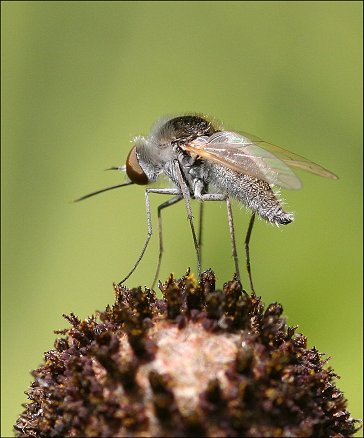
Bombyliidae: Geron sp.

You know I have a bit of an obsession with bee flies, even ones I haven't seen myself. Here's a cutie I found today. The odonata update is below.


This tiny, hump-backed little bee fly is probably from the genus Geron.

A Spreadwing Update

Yesterday, I spent some time at the University of Michigan Museum of Zoology in the odonata range with the accomodating and helpful Mark O'Brien, researching some of the species that have been recorded in Wayne Co. that I personally have not seen. The big news, I guess, is that Elegant Spreadwing, Lestes inaequalis, is now striken from the list. It's inclusion was based on a lone record, a female specimen taken several years ago. I took a look at it, and lo and behold, it was mislabeled (note, MFO: I could have said "misidentified"). Males are easy to ID, their inferior (lower) claspers are longer than the superior (top) ones. You can kind of see this in the photos here and here, but it's really obvious in the hand, even without magnification. Females ("Lestes without testes" Mark calls them), however, usually require a microscope and some experience. I've looked all over hell's half-acre in the county for this species, but so far no luck.

We also went over some literature records. Several are from prior to 1880 (Hagen's Bluet, Enallagma hageni; Canada Darner, Aeshna canadensis; Mottled Darner, A. clepsydra; and Williamson's Emerald, Somatochlora williamsoni), and others might be in error. Of the 90 species on the checklist, there are only 13 I haven't seen, and half of them are species that either haven't been seen for over 100 years or that I suspect are in error. Eventually, Mark and I became sidetracked into reading some of the correspondence given to the museum by E. B. Williamson (the MOS newsletter's namesake) from colleague Clarence Kennedy. I always find it interesting to get to know historical figures from a personal perspective rather than just seeing their published papers and the results of their field work. Let's just say that these two men were particularly intriguing; Mark promises to liven up our winter months summarizing some of these riveting letters in his blog.

Today I was hoping to find either Elegant Spreadwing or Common/Southern Spreadwing (Lestes disjunctus disjunctus and L. d. australis). There actually aren't that many L. d. disjunctus specimens from southern Michigan; I don't find them all that common. There are just a smattering of L. d. australis specimens from the state.

Now that I have a bike rack, I'm able to explore further afield at the metroparks. There is a 3-mile stretch between Lower Huron and Willow metroparks that, from an aerial view, looked to have a nice old wooded oxbow near the bike path, so that's where I headed. This was nearly all dried up, just squishy much and lots of wetland vegetation. It was loaded with Lestes, mostly Sweetflag Spreadwing, L. forcipatus. Wherever I find these, I find A LOT of them. The males look pretty much like Common Spreadwings. The easiest thing to do is catch a pair and take a look at the female. If her ovipositor is longer than her superior anal appendages, like this, then it's a pair of Sweetflags. I netted every nth pair that I couldn't get a good look at through binoculars, but could not come up with Common/Southern. There were a smattering of Slender Spreadwings, L. rectangularis, some Ruby Meadowhawks, Sympetrum rubicundulum, and the many of the ubiquitous Blue-fronted Dancers, Argia apicalis. Despite the lack of diversity, this looks like a great spot earlier in the season, and later on for patrolling Aeshnas. I'm headed to a different spot furthern downriver tomorrow.

20 July 2005

Skimming Bluet

Getting tired of seeing me post damselfy photos? Well, for me, the bluets are like miniature shards of the deep blue July sky, skittering through the grass at my feet, and symbolic of the summer season I love so much.

Skimming Bluets (Enallagma geminatum) are very dainty, and usually seen dancing over glassy-surfaced ponds. This one paused nearby for me to admire.