30 May 2011

2nd visit to Maybury State Park

With early dragonflies on the mind that would make new records for the county, I headed to Maybury State Park in northwestern Wayne County on May 30th. My first visit of the year a week ago only provided a female Common Whitetail (Plathemis lydia).

No luck with new species for the county, but I did see a couple new species for the season.

Several Ebony Jewelwings (Calopteryx maculata) were flitting about Sump Drain:


A few baskettails (Epitheca sp.) were patrolling the forest clearings. I caught one male and will try to ID it at a later date. It may be Common (E. cynosura) or Stripe-winged (E. costalis):


A nice surprise was a young male Arrowhead Spiketail (Cordulegaster obliqua) perching in a small Prickly Ash:


Next I'll look for this species in another county.

29 May 2011

Slow start to the southeast Michigan ode season

I was looking forward to making a post on an earlier date, but we've had an extremely cold and wet spring. I believe it's the 2nd wettest spring on record for this area.

Up through today (May 29th), I've only tallied 6 species of odonata of only several individuals. Below is my meager list of first dates:

- Fragile Forktail (Ischnura posita) = emerging individuals mid-May in Farmington Hills

- Eastern Forktail (Ischnura verticalis) = emerging individuals mid-May in Farmington Hills. Here's a fairly teneral female from 5/19:


- Common Green Darner (Anax junius) = one male on 5/5 in Farmington Hills

- baskettail sp. (Epitheca sp.) = 6+ on 5/29 at UM-Dearborn. These were likely Common (E. cynosura), but could have the possibility of being Stripe-winged (E. costalis).

- Dot-tailed Whiteface (Leucorrhinia intacta) = one young male on 5/29 at UM-Dearborn:


- Common Whitetail (Plathemis lydia) = one teneral female at Maybury State Park on 5/22. Here's a teneral male found 5/23 in Farmington Hills:


Don't worry, there is more to come. Although we could see a lower number of river and stream species this year due to the excessive flooding experienced this spring.

17 May 2011

New books, with UDH photos

A couple of books have come out recently that are worth adding to any insect lover's library. Not only that, an Urban Dragon Hunter contributed a photo to each.


First up is the excellent Attracting Native Pollinators: The Xerces Society Guide to Conserving North American Bees and Butterflies and Their Habitat. The Xerces Society, a well-respected invertebrate conservation organization, really went all out in this book. Chapters cover pollination, pollinators, and pollinator conservation, and every aspect of how to manage land, greenspaces, and gardens to provide nest sites, foraging habitat, and wintering sites for pollinators. Another section describes the bees of North America by family and subfamily. The photo illustrating the account of the genus Stelis (a cuckoo bee) was taken by Nannothemis in the Urban Dragon Hunter backyard. For a few years, we have photographed and tried to identify all the Hymenoptera and Diptera in the yard. We were happy to make this contribution to the Xerces Society, especially for such a terrific book. If you have even a passing interest in pollinators or landscaping for wildlife, get this book.


Next up we move on to another taxa with The Complete Book of North American Butterflies. This is a beautiful book that, ironically, does not cover all the butterflies of the continent. The first 60 pages or so provide an overview the Lepidopteran life cycle. Most of the remainder of the volume gives summaries of the six families of butterflies in North America with brief, representative species accounts. There are over 700 species of butterflies in N.A. (there is a list in the back of the book), but fewer than 100 are described. Nonetheless, these accounts are succinct but thorough and each features one or two excellent photos. Nannothemis contributed a shot of a Little Wood Satyr that appears in both the "self-defense" section and on the back cover of the book. This book will be released next month, and would make a great introduction for a new butterfly enthusiast.

09 April 2011

Ode habitats at El Jaguar Reserve

As a followup to the 2011 Nicaraguan ode shots in the previous post, here are habitat shots to help give a sense of the terrain.

Finca Esperanza Verde
(FEV) and General Nestor's were highlighted previously here.

This post will focus on our visit to a finca in the department of Jinotega.

EL JAGUAR RESERVE (EJ) -- cloud forest including a sustainable coffee farm, near El Mojon

-- Ariel El Dorado, near Forest MoSI station: 13.234785, -86.054017, 1270+ m
During our first full day (March 9th) we visited the forest MoSI station. A large tree had fallen near the bird banding station which created a sunlit patch in the forest and several teneral or young damselflies were present.


-- Ariel El Dorado, "pond area": 13.23432, -86.05405, ~1270 m
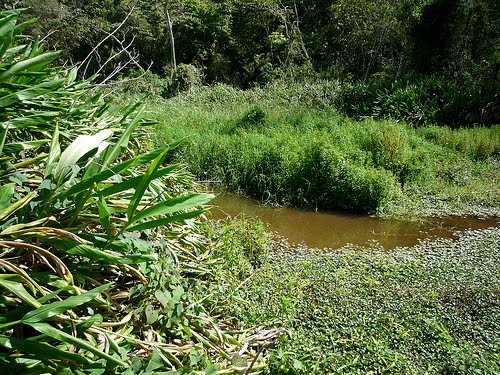
This is a spring-fed stream that begins in the hillside and flows through the forest down to a low, open area that creates a wide spot (almost a pond).

The stream is rocky in the forest area, and the sunny rocks are ode hotspots:


The wide spot downstream was truly the ode hotspot we found at El Jaguar. The edges were quite silty and could "swallow a man alive". With a little caution, one could navigate the edges.


-- Uriel La Pedegrosa: 13.234418, -86.052895, ~1273 m
This is a small stream that runs from the hills through the middle of the reserve. For some reason, I didn't save any photos from this location. In general, it's similar to the Ariel El Dorado forest portion, but a little muddier.

-- Finisterra, below the Coffee MoSI station: 13.233472, -86.051930, ~1273 m
This is also a small stream that runs through the hills, but its origin is in the neighbor's property. This waterway had the fewest dragonflies and may be due to the neighbor's use of chemicals for agriculture and/or soaps for washing.


-- two-tracks in the finca
The roadways throughout the farm also provided areas to find patrolling darners, skimmers or ode hunters.


03 April 2011

Return to Nicaragua

We made a return trip to Nicaragua in March 3-12, 2011. Our main task was to help with a bird banding project again, but we also did ode surveys at several locations -- and we had permission to net and release at each location, which was a big help. We ended up confirming 20 species, with a few other possibles, which isn't too bad considering that our visit was during the winter months.

Finca Esperanza Verde and General Nestor's were both visited in our 2009 trip which is summarized here. The numbers of individuals seemed to be greater this year than during the 2009 trip. This could have been due to the wetter fall/winter due to the La Nina year.

The new locations we visited were a stream crossing near Yucul due to a flat tire and El Jaguar Reserve.

LOCATIONS VISITED

FINCA ESPERANZA VERDE (FEV) -- shade coffee farm near San Ramon, Matagalpa dept.
-- Main buildings: 12.93978, -85.78003, 1100 m
-- Yellow trail creek: 12.93398, -85.78248, 1100 m
-- Blue trail creek: 12.9382, -85.7814, ~1073 m
-- Red trail: 12.944464, -85.777693, ~1054 m

Stream crossing near Yucul (YU) -- roadside, Matagalpa dept.: 12.91782, -85.78248, ~950 m

"GENERAL NESTOR'S" (GN) -- private property near El Naranjo, Matagalpa dept.: 12.89714, -85.78798, 688 m. Actually, General Nestor doesn't own it any longer, but the new owner allowed access.

EL JAGUAR RESERVE (EJ) -- cloud forest including a sustainable coffee farm, near El Mojon, Jinotega dept.
-- Ariel El Dorado, near Forest MoSI station: 13.234785, -86.054017, 1270+ m
-- Ariel El Dorado, "pond area": 13.23432, -86.05405, ~1270 m
-- Uriel La Pedegrosa: 13.234418, -86.052895, ~1273 m
-- Finisterra, below the Coffee MoSI station: 13.233472, -86.051930, ~1273 m


FINCA ESPERANZA VERDE

Male Hetaerina capitalis, several found along the red trail.

Female Great Spreadwing, Archilestes grandis, found near the blue trail.

Male Argia anceps, found along the red trail.

Male Spine-tipped Dancer, Argia extranea, numerous near the main buildings.

Male Brechmorhoga rapax, one found along the red trail.

Female Red Rock Skimmer, Paltothemis lineatipes, one found near the main buildings.

Species seen at FEV:
  1. Hetaerina capitalis
  2. Hetaerina cruentata
  3. Great Spreadwing (Archilestes grandis)
  4. Cerulean (or Dusky) Dancer (Argia anceps)
  5. Spine-tipped Dancer (Argia extranea)
  6. Brechmorhoga rapax
  7. Red Rock Skimmer (Paltothemis lineatipes)

Stream crossing near YUCUL

Male amberwing (Perithemis sp., likely mooma).

Male Neon Skimmer (Libellula croceipennis).

GENERAL NESTOR'S

A gathering of Argia (Nannothemis did a slip-and-slide, killing her camera in the process).

Coupled Fiery-eyed Dancers (Argia oenea).

Male Brown Setwing (Dythemis sterilis).

Male skimmer (Orthemis sp.), debate whether this is ferruginea or schmidti
Coincidentally, there is the same area we had a female Orthemis 2 years ago that was confusing.

Species seen at GN:
  1. Hetaerina capitalis
  2. Hetaerina cruentata
  3. Great Spreadwing (Archilestes grandis)
  4. Spine-tipped Dancer (Argia extranea)
  5. Fiery-eyed Dancer (Argia oenea)
  6. darner sp. (likely Anax amazili?)
  7. Brown Setwing (Dythemis sterilis)
  8. Erythrodiplax sp.
  9. Red Rock Skimmer (Paltothemis lineatipes)
  10. skimmer sp. (Orthemis ferruginea or schmidti)
  11. Filigree Skimmer (Pseudoleon superbus)
  12. Perithemis mooma

EL JAGUAR RESERVE


Male Hetaerina cruentata, the only rubyspot species found at EJ in numerous locations.

Male Acanthagrion trilobatum, a couple males found near the pond of Ariel El Dorado.

Male Anisagrion allopterum, found in a multiple locations.

Male Argia anceps, found in multiple locations.

Male Spine-tipped Dancer, Argia extranea, found in multiple locations.

Male Argia oculata, type "B", a couple found on Ariel El Dorado below the forest MoSI (bird banding) station.

Male Rhionaeshna jalapensis, found on the pond of Ariel El Dorado.

Female Malachite Darner, Remartinia luteipennis, ovipositing on the pond of Ariel El Dorado. A male was captured in the bird banding nets in the coffee area as well.

Male Brechmorhoga rapax, a couple found on Ariel El Dorado below the forest MoSI station.

Male Red-faced Dragonlet, Erythrodiplax fusca, multiples on the Ariel El Dorado pond.

Male Libellula foliata, a couple found on the Ariel El Dorado pond.

Male Cardinal Meadowhawk, Sympetrum illotum, multiples around the Ariel El Dorado pond.

Species seen at EJ:
  1. Hetaerina cruentata
  2. Acanthagrion trilobatum
  3. Anisagrion allopterum
  4. Argia anceps
  5. Spine-tipped Dancer (Argia extranea)
  6. Argia oculata, type B
  7. Rhionaeshna jalapensis
  8. Malachite Darner (Remartinia luteipennis)
  9. Brechmorhoga rapax
  10. Erythrodiplax fusca
  11. Libellula foliata
  12. skimmer sp. (Orthemis, ferruginea or discolor)
  13. Filigree Skimmer (Pseudoleon superbus)
  14. amberwing sp. (Perithemis, likely mooma)
  15. Cardinal Meadowhawk (Sympetrum illotum)
Species richness could be much greater at all of these locations during portions of the year with warmer and wetter weather. Hopefully, we'll be able to visit again in future years.