09 April 2011

Ode habitats at El Jaguar Reserve

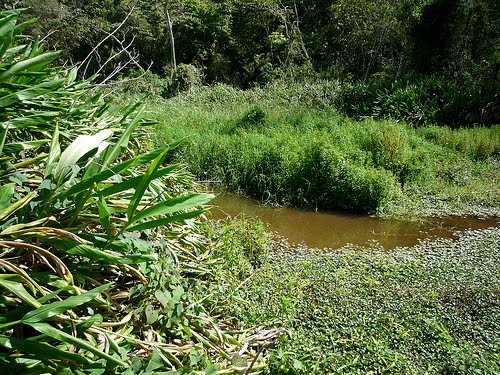
As a followup to the 2011 Nicaraguan ode shots in the previous post, here are habitat shots to help give a sense of the terrain.

Finca Esperanza Verde
(FEV) and General Nestor's were highlighted previously here.

This post will focus on our visit to a finca in the department of Jinotega.

EL JAGUAR RESERVE (EJ) -- cloud forest including a sustainable coffee farm, near El Mojon

-- Ariel El Dorado, near Forest MoSI station: 13.234785, -86.054017, 1270+ m
During our first full day (March 9th) we visited the forest MoSI station. A large tree had fallen near the bird banding station which created a sunlit patch in the forest and several teneral or young damselflies were present.


-- Ariel El Dorado, "pond area": 13.23432, -86.05405, ~1270 m
This is a spring-fed stream that begins in the hillside and flows through the forest down to a low, open area that creates a wide spot (almost a pond).

The stream is rocky in the forest area, and the sunny rocks are ode hotspots:


The wide spot downstream was truly the ode hotspot we found at El Jaguar. The edges were quite silty and could "swallow a man alive". With a little caution, one could navigate the edges.


-- Uriel La Pedegrosa: 13.234418, -86.052895, ~1273 m
This is a small stream that runs from the hills through the middle of the reserve. For some reason, I didn't save any photos from this location. In general, it's similar to the Ariel El Dorado forest portion, but a little muddier.

-- Finisterra, below the Coffee MoSI station: 13.233472, -86.051930, ~1273 m
This is also a small stream that runs through the hills, but its origin is in the neighbor's property. This waterway had the fewest dragonflies and may be due to the neighbor's use of chemicals for agriculture and/or soaps for washing.


-- two-tracks in the finca
The roadways throughout the farm also provided areas to find patrolling darners, skimmers or ode hunters.


03 April 2011

Return to Nicaragua

We made a return trip to Nicaragua in March 3-12, 2011. Our main task was to help with a bird banding project again, but we also did ode surveys at several locations -- and we had permission to net and release at each location, which was a big help. We ended up confirming 20 species, with a few other possibles, which isn't too bad considering that our visit was during the winter months.

Finca Esperanza Verde and General Nestor's were both visited in our 2009 trip which is summarized here. The numbers of individuals seemed to be greater this year than during the 2009 trip. This could have been due to the wetter fall/winter due to the La Nina year.

The new locations we visited were a stream crossing near Yucul due to a flat tire and El Jaguar Reserve.

LOCATIONS VISITED

FINCA ESPERANZA VERDE (FEV) -- shade coffee farm near San Ramon, Matagalpa dept.
-- Main buildings: 12.93978, -85.78003, 1100 m
-- Yellow trail creek: 12.93398, -85.78248, 1100 m
-- Blue trail creek: 12.9382, -85.7814, ~1073 m
-- Red trail: 12.944464, -85.777693, ~1054 m

Stream crossing near Yucul (YU) -- roadside, Matagalpa dept.: 12.91782, -85.78248, ~950 m

"GENERAL NESTOR'S" (GN) -- private property near El Naranjo, Matagalpa dept.: 12.89714, -85.78798, 688 m. Actually, General Nestor doesn't own it any longer, but the new owner allowed access.

EL JAGUAR RESERVE (EJ) -- cloud forest including a sustainable coffee farm, near El Mojon, Jinotega dept.
-- Ariel El Dorado, near Forest MoSI station: 13.234785, -86.054017, 1270+ m
-- Ariel El Dorado, "pond area": 13.23432, -86.05405, ~1270 m
-- Uriel La Pedegrosa: 13.234418, -86.052895, ~1273 m
-- Finisterra, below the Coffee MoSI station: 13.233472, -86.051930, ~1273 m


FINCA ESPERANZA VERDE

Male Hetaerina capitalis, several found along the red trail.

Female Great Spreadwing, Archilestes grandis, found near the blue trail.

Male Argia anceps, found along the red trail.

Male Spine-tipped Dancer, Argia extranea, numerous near the main buildings.

Male Brechmorhoga rapax, one found along the red trail.

Female Red Rock Skimmer, Paltothemis lineatipes, one found near the main buildings.

Species seen at FEV:
  1. Hetaerina capitalis
  2. Hetaerina cruentata
  3. Great Spreadwing (Archilestes grandis)
  4. Cerulean (or Dusky) Dancer (Argia anceps)
  5. Spine-tipped Dancer (Argia extranea)
  6. Brechmorhoga rapax
  7. Red Rock Skimmer (Paltothemis lineatipes)

Stream crossing near YUCUL

Male amberwing (Perithemis sp., likely mooma).

Male Neon Skimmer (Libellula croceipennis).

GENERAL NESTOR'S

A gathering of Argia (Nannothemis did a slip-and-slide, killing her camera in the process).

Coupled Fiery-eyed Dancers (Argia oenea).

Male Brown Setwing (Dythemis sterilis).

Male skimmer (Orthemis sp.), debate whether this is ferruginea or schmidti
Coincidentally, there is the same area we had a female Orthemis 2 years ago that was confusing.

Species seen at GN:
  1. Hetaerina capitalis
  2. Hetaerina cruentata
  3. Great Spreadwing (Archilestes grandis)
  4. Spine-tipped Dancer (Argia extranea)
  5. Fiery-eyed Dancer (Argia oenea)
  6. darner sp. (likely Anax amazili?)
  7. Brown Setwing (Dythemis sterilis)
  8. Erythrodiplax sp.
  9. Red Rock Skimmer (Paltothemis lineatipes)
  10. skimmer sp. (Orthemis ferruginea or schmidti)
  11. Filigree Skimmer (Pseudoleon superbus)
  12. Perithemis mooma

EL JAGUAR RESERVE


Male Hetaerina cruentata, the only rubyspot species found at EJ in numerous locations.

Male Acanthagrion trilobatum, a couple males found near the pond of Ariel El Dorado.

Male Anisagrion allopterum, found in a multiple locations.

Male Argia anceps, found in multiple locations.

Male Spine-tipped Dancer, Argia extranea, found in multiple locations.

Male Argia oculata, type "B", a couple found on Ariel El Dorado below the forest MoSI (bird banding) station.

Male Rhionaeshna jalapensis, found on the pond of Ariel El Dorado.

Female Malachite Darner, Remartinia luteipennis, ovipositing on the pond of Ariel El Dorado. A male was captured in the bird banding nets in the coffee area as well.

Male Brechmorhoga rapax, a couple found on Ariel El Dorado below the forest MoSI station.

Male Red-faced Dragonlet, Erythrodiplax fusca, multiples on the Ariel El Dorado pond.

Male Libellula foliata, a couple found on the Ariel El Dorado pond.

Male Cardinal Meadowhawk, Sympetrum illotum, multiples around the Ariel El Dorado pond.

Species seen at EJ:
  1. Hetaerina cruentata
  2. Acanthagrion trilobatum
  3. Anisagrion allopterum
  4. Argia anceps
  5. Spine-tipped Dancer (Argia extranea)
  6. Argia oculata, type B
  7. Rhionaeshna jalapensis
  8. Malachite Darner (Remartinia luteipennis)
  9. Brechmorhoga rapax
  10. Erythrodiplax fusca
  11. Libellula foliata
  12. skimmer sp. (Orthemis, ferruginea or discolor)
  13. Filigree Skimmer (Pseudoleon superbus)
  14. amberwing sp. (Perithemis, likely mooma)
  15. Cardinal Meadowhawk (Sympetrum illotum)
Species richness could be much greater at all of these locations during portions of the year with warmer and wetter weather. Hopefully, we'll be able to visit again in future years.

26 February 2011

A day with really old dead things

We are finally getting at writing a paper on the Odonata of Wayne County, Michigan. The ten years of collecting has been fun. The digging very meticulously through old literature and verifying specimens -- not so much.

The University of Michigan Museum of Zoology has the second largest collection of Odonata in the country, with something like 300,000 specimens of around 3,000 species. There is also a boatload of old literature, correspondence, and journals, and best of all, a collection manager that rocks: Mark O'Brien. I (Nannothemis) am in the home stretch of determining which species to include in the Wayne County checklist, so it was time to once again head up to the UMMZ and tie up some loose ends.

The main goal was to verify the identity, or existence, of some specimens mentioned in the literature by three of the earliest authors of checklists of Michigan odes: Hermann Hagen (late 1800s), Francis Byers (1920s), and Edward Kormondy (1950s). Sometimes a single species would be mentioned by Hagen and repeated by Byers and Kormondy, who may or may not have actually examined some specimen that was still (at that time) in the UMMZ. Such was the case with Spiny Baskettail (Epitheca spinigera). From its first mention by Hagen in 1875, a single specimen from Detroit was mentioned in several papers as well as correspondence. Unfortunately, it was identified by at least four different names and three different species. Mark and I looked high and low for it. We did find another specimen that was usually mentioned as part of the same group, in a drawer of type specimens.

In the early 1900s, it was used to describe "Tetragoneuria morio" later considered a synonym for T. cynosura, now called Common Baskettail, Epitheca cynosura. This specimen was from Maine. We never did find the Detroit specimen in order to figure out what species it may have been. It might have been eaten by a mouse around 1910, according to some correspondence in the files.

All of the Michigan specimens in the collection are databased, but there were a few that I wanted to double-check. The identification of most has been checked by an expert somewhere along the line, but frankly after a lot of scrutiny I had found that some of them were a little sloppy (sorry, Kormondy).

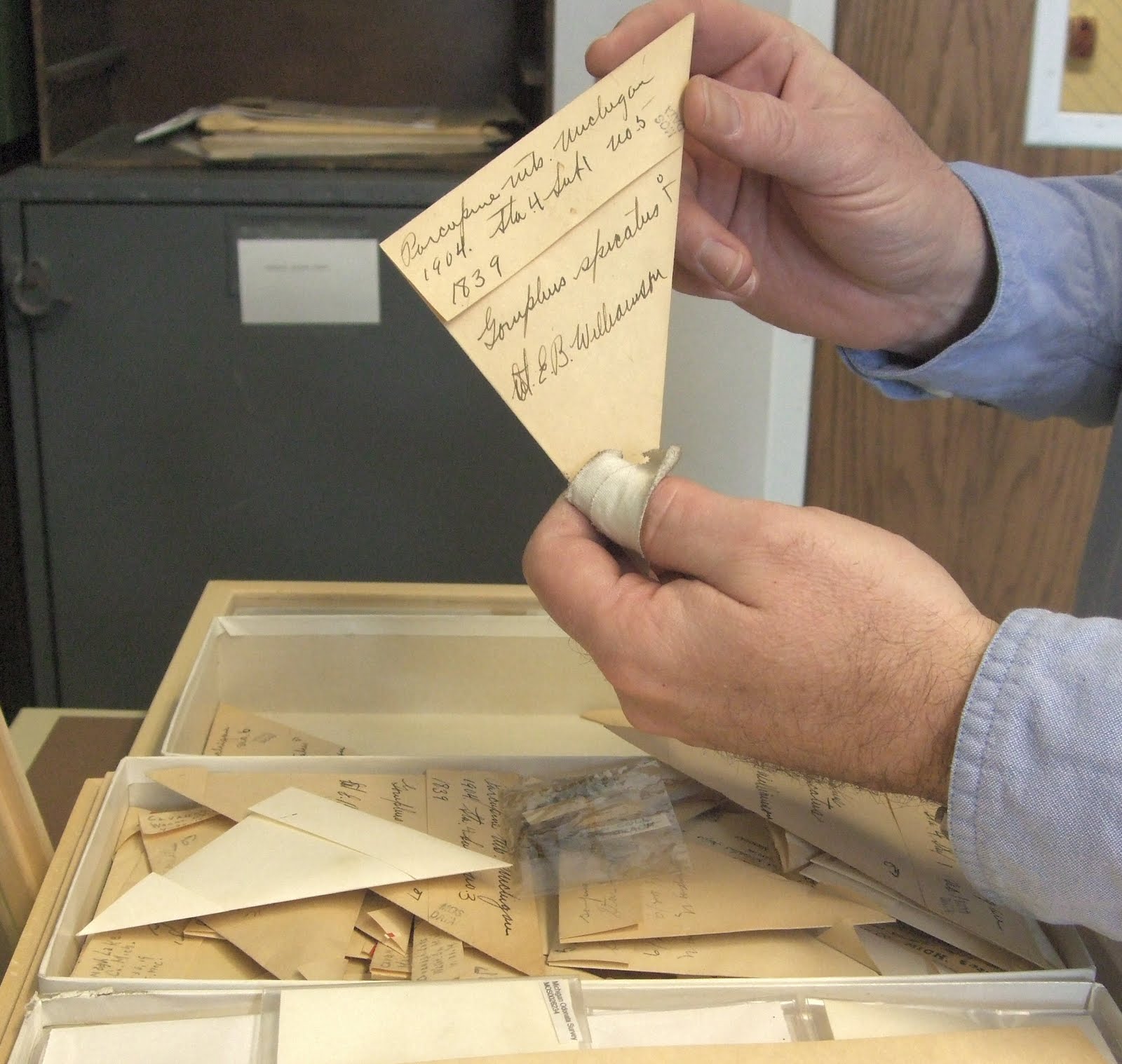
Today, adult Odonata specimens are stored in a clear envelope with a card that includes all the collection data. Back in the day, however, they were folded up in paper triangles. Lots of them. Boxes and drawers of them. For common species, such as Dusky Clubtail (Gomphus spicatus), we had to mine through a ton of envelopes to find the one I was looking for. It was one that had been misidentified in the literature, and corrected by a later author. I just wanted to make sure it was right.

One other task was to try to figure out the exact locations of some of the specimens. In particular, William W. Newcomb did lots of collecting in southeast Michigan in the early 1900s. Some of his specimens are from Wayne County, and sometimes used now non-existent street names for specific sites. I believe I know where most of them are using old maps, but I knew the UMMZ had some of his old journals. Unfortunately, the first one available was dated 1911, and I was aiming for 1903-1905. The available journals were written in beautiful, small script, often illustrated with these carefully drawn maps:

I didn't find what I was looking for, but one day, I'll just have to read through Newcomb's journals. They are gorgeous, and highlight plenty of places right around home.

In the end, I resolved most of my questions. There will be about a dozen species that have been attributed to Wayne County in past literature that we were unable to corroborate with a specimen, or turned out to be misidentified. These incorrect records just keep perpetuating themselves in the literature until someone is determined to finally figure out what is really what.

The final tally, by the way, is 89 species now represented by valid vouchers, all in the UMMZ. We've found over 30 of them. There are 5 additional species we consider "hypothetical" as we have sight or photo records, but no specimens. We'll be putting together a new checklist soon.

23 December 2010

A washout in Panama

We made a trip to Panama in late November-2010 and stayed at The Canopy Tower. (If you haven't been to the rainforest, this is a great place to get an introduction.)


Our intent for this trip was to visit Pipeline Road regularly and record the various insects and birds for a few days.

It was the end of the rainy season so we expected to have rain for a bit each day. What do you expect in the rainforest? However, we didn't take into account that it was a La Nina year. The first day or two of our stay had a bit more rain that we'd experienced in previous trips which was no big deal.

However, the remainder of the trip involved rain, with only short periods of hot, humid weather. We didn't find many dragonflies during the limited "dry" periods. Following is a list of the locations we visited and the relatively few odes encountered.

Plantation Road in Soberania National Park:
The trailhead to this great path is at the base of Semaphore Hill (where The Canopy Tower is located).

On the morning of November 26th, we hiked ~3km of the path and found a few individual dragonflies. The mammals were the most numerous with a troop of Mantled Howler Monkeys and White-faced Capuchins lounging over the trail.

One Uracis imbuta was perched out at the trailhead:


One male rubyspot (Hetaerina sp.) was found ~1km:


One male Argia (possibly oculata) was perched ~1km:


Two female Blue-fronted Setwings (Dythemis multipunctata) were found at ~1.5km. Here is one:


We also found two helicopter damselflies (Megaloprepus caerulatus) but they didn't cooperate for photos.

On the afternoon of November 28th we returned and found dragonflies to be gathered at, or near, the trailhead.

One female Argia (likely oculata):


One female of a couple Blue-fronted Setwings (Dythemis multipunctata):


One female Macrothemis sp.:


Additionally, there were many saddlebags (likely Striped, Tramea caverti) and gliders (Pantala sp.) working the open area above the parking lot for a couple hours before sunset.

The Ammo Dump Ponds near Gamboa have great potential for a variety of odes. A brief afternoon visit in the rain on November 26th provided a couple species.

One male Flame-tailed Pondhawk (Erythemis peruviana):


One female that is likely Erythrodiplax fervida:


The Discovery Center is a great destination along Pipeline Road. This building and trails opened a few years ago. Brewed coffee is sold on the porch at the visitors center (a great relief from the drenching rains). The trails pass a couple small creeks and there's an overlook at a lagoon.
On the morning of November 27th, we found a few individuals before the rains arrived for the day.

One male rubyspot (probably Hetaerina miniata):


One male Argia (likely pulla) was found near Lake Calamito:


One male Blue-fronted Setwing (Dythemis multipunctata) was found at the stream near the visitor's center:


One male Flame-tailed Pondhawk (Erythemis peruviana) was near the parking lot:


Pipeline Road is a must if one visits the area. There are many opportunities to explore many river crossings. Sadly, it rained on us almost the entire time of our visits to this great location. Here's one instant without rain at Rio Frijoles:


The insect highlights of the trip were found at The Canopy Tower. During the last two nights of our stay, the staff put up a white sheet with a black light to attract moths. This attracted dozens of species, along with other interesting insects. We haven't identified most of the moths, but they can be viewed in the latter half of the Flickr set here or this Flickr set here. I didn't add moth photos here since I can't decide which are the coolest, but here are a couple of non-leps:


The rains continued after we left and truly caused problems:
- The Panama Canal was closed for one day.
- A portion of the Centennial Bridge washed out.
- Here's an incredible video showing the level of water and the force of the rains. This is the bridge one uses to access Gamboa and the Pipeline Road Area from Panama City.

Hopefully your future travels avoid rains such as this.

11 December 2010

Got bugs? Get Pentax Papilio binoculars

The fundamental tools-of-the-trade for a field ecologist are pretty basic: good boots, "Rite-in-the-Rain" notebooks, and binoculars. For a long time, I only had two pairs of binoculars: my good Leica bins and a cheaper pair I wear bird banding (a lesson I learned when I had to send my Leicas in for professional cleaning when errant bird poop finally froze up the eye pieces). Soon I felt the need for a little travel pair to keep in the car.
Then, middle age rudely diminished the close-focus range of any binocular I owned. As I started doing more grant work involving insects, especially dragonflies, I found that I needed not only a good insect net, but bins with really good close focus. Late this summer, I picked up a pair of Pentax Papilio 8.5x21 binoculars.

They* rock! Advertised close focus is 18 inches, easily obtainable. I thought that sometimes I could get even closer. This is achieved through some sort of optics magic. The blurb at the Pentax web site explains it is via "new design technology that automatically compensates for the misalignment of right and left image fields at close ranges." I read that the close focus amounts to holding something ten inches from your face and looking at it with a 5x hand lens. Since I do a lot of insect surveys, this is extremely worthwhile. The image is bright and clear. When I took a look at my first fly in the yard, it reminded me of when I first got glasses as a kid -- a kind of "wow" experience.

Whereas good high-end birding binoculars only take a half turn of the focus knob to go from at-your-feet to in-the-next-county, the Papilios offer sharp focus at close range through many swipes of the knob. Switching back and forth between my birding bins and the Papilios is a little challenging because they are so different. The Paps are adequate for casual birding, but the need to paw at the focus means a bird flying by you as you are examining a Monarch will likely go unidentified. It just takes too long to get on a moving object and focus.

Field of view on the 8.5 x 21's is 315 feet; it's 393 on the 6.5x21 model.

The Papilios are very lightweight (10.2 oz) and small (less than 5 x 5 inches). I typically kept them tucked in the front pocket of my camera bag when I was doing serious field trips, but often had them around my neck in the yard, where they were easily forgotten. The strap attachment is the most hassle-free I have encountered in neck-dangling optics: a post-in-groove locking arrangement. It's not only quick and secure, but allows very free swiveling movement. While it eliminated the tedious process of having to thread a strap through a little potentially-fragile loop on the bin body, it also prevents replacement of the rather standard webbed nylon strap with anything else but another strap with the same attachment. However, at this light weight, a padded strap isn't necessary.

The bins have a rubberized coating, but are not waterproof or fogproof. I did have them on our rainy Panama trip, and had no problems, although admittedly there were not a lot of insects out in the rain to look at.

Other features include fully multi-coated lenses, 15 mm eye relief, and a threaded hole on the bottom for tripod attachment.

I'm really pleased with these binoculars (this binocular!), especially at their very reasonable price. I'd recommend them to anybody who likes to look at insects, if you need a spare pair of travel bins, or even for casual or beginning birders, who often start out looking at close-by birds anyway.


Cross-posted at bootstrap analysis.

*A pair of binoculars is really an "it." This sounds weird to me. I'm going to try to let my hair down here.