

10 June 2005
Update
It's been HOT. The weather we never had in July and August 2004 is here now. Odes are popping out all over. I have seen most of the expected species. Today, I had my first Unicorn Clubtail, Arigomphus villosipes, one of the easier gomphids to recognize; the males have those groovy all-yellow cerci.
04 June 2005
Clubtails and damsels, oh my

Aurora Damsel (Chromagrion conditum). Click me.
Today Stylurus had to lead a bird walk for an Audubon group in nearby Lenawee County. We like Lenawee Co., it's the closest area to here that feels somewhat rural, and we've enjoyed past ode hunting expeditions to interesting habitats like Ives Road Fen and along the River Raisin.
After the bird trip, we went for a walk along the mill race of the River Raisin at Indian Crossing Trails Park. In a quiet little pond off the trail, I found a number of bluets. Seen from above (uh, above) the ID didn't come to mind, but once I netted one, I saw the pretty yellow patch on the bottom of the thorax and realized I had Aurora Damsel, a new county record. I'm just learning how to use a new camera, so when I found a pair together, I didn't get the whole operation in focus, but you can see the color patterns of both sexes.

Pair of Aurora Damsels getting ready for the wheel of love. Click us.
Along the wood chipped trail next to the mill race we soon flushed a gomphid, which perched up in a tree. It was very teneral, mostly pale yellow. We combined all the segments of both of our nets to try to reach it. Stylurus had the honors, since he's 14 inches taller than I am. Even so it was a stretch, and it took him three tries (each a hearty whack on the limb where the thing was perched, not budging it) before we got it. Crap, another female. Thinking I suddenly knew all about female genitalia plates, I flipped it over. Hmm, the naughty bits looked a little like Gomphus spicatus, but clearly this girl was far too big. Staring at it, I suddenly noticed the long spines on the thighs. "Oh, duh!" I said to my man, "It's a Dromogomphus!" The dark shoulders were just beginning to darken on this fresh individual, clinching the ID as a Black-shouldered Spinylegs, another county record that we'd been after for a couple of years.
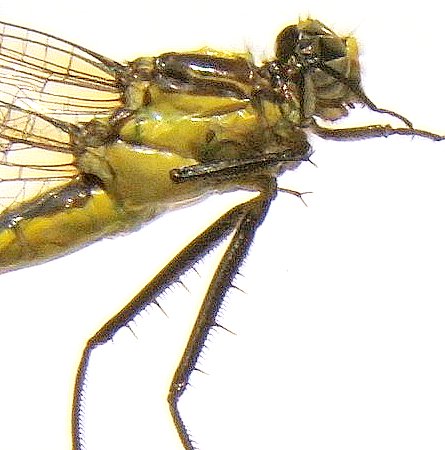
Black shoulder, spiny legs = Black-shouldered Spinylegs (Dromogomphus spinosus)! Don't bother clicking me, I'm already low resolution.
Stylurus spotted a stunning blue-spotted, blue-eyed darner patrolling the water. There's only one aeshnid like that around this time of year: Springtime Darner (Basiaeschna janata). We stood on shore waiting for it to come close by, but although it was chasing bits of cottonwood fluff, it really never got within striking distance. This was a "lifer" for me. As we were watching, another small gomphid flew by a few times. Stylurus snagged one when it landed on the trail: a male Lancet Clubtail.
It had been an early morning, so we headed for home. Other species we saw today were Double-striped Bluet (Enallagma basidens), new early record for the state (based on specimen records); Ebony Jewelwing (Calopteryx maculata), Eastern Forktail (Ishnura hastata), Common Baskettail (Epitheca cynosura), and Common Green Darner (Anax junius).
30 May 2005
Our favorite retention ponds
We didn't really intend to go out today, the weather was supposed to be lousy. When the sun came out, we decided to go up to the northwestern corner of the county for a brief visit to the retention ponds at a partially developed office complex. There are only a couple of office buildings up, and once all the outlots are filled these little marshy areas will be inundated by parking lot runoff and be ruined. Meanwhile, they are clinging to their character, which must be influenced by some acid water or boggy heritage. Here, in this most unlikely place, we've found boggy species: Eastern Red Damsel (Amphiagrion saucium), Sedge Sprite (Nehalennia irene), Citrine Forktail (Ischnura hastata), and my namesake Elfin Skimmer (Nannothemis bella). All were county records and with the exception of the forktail, all have been found no place else in the county. Today the red damsels were on the wing, even though the basins/marshy spots were fairly dry. We saw the first Dot-tailed Whitefaces (Leucorrhinia intacta), Eastern Pondhawks (Erythemis simplicicollis), and Twelve-spotted Skimmers (Libellula pulchella) of the season, and Eastern Forktails were numerous.
29 May 2005
Lancet Clubtail

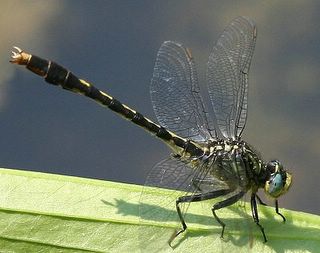
Teneral female Lancet Clubtail (Gomphus exilis)
Another stab at a decent voucher for Lancet Clubtail today at Sherwood Park. Of course, by the time I got off work and we got out there, the sunny, calm day had turned cloudy, windy, and threatened rain. This was the only dragonfly I saw, as we were walking back to the car, but it was the sought-after species, the dainty little Lancet Clubtail.
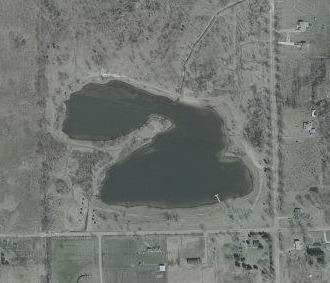
Sherwood Park, Sumpter Twp., Wayne Co., MI (northwest corner of Sherwood & Wear roads)
28 May 2005
I hate female gomphids! But love new records
Finally, it's been sort of warm for a few days -- something must be emerging! Stylurus and I went to some of our favorite sandy ponds to look for those annoying early gompids. First stop, Oakwoods Metropark. We've had some very good gomphids here, including the state's first record of Flag-tailed Spinyleg (Dromogomphus spoliatus), although we were unable to voucher the first record. Stylurus decided he needed to stand around in the woods to listen for Acadian Flycatchers, so I kicked around in the weeds near a pond. Only a few glistening-winged teneral odes flew up, but I snagged this one, a female Pronghorn Clubtail. In 2003, we vouchered the first county record of this species at the same location.
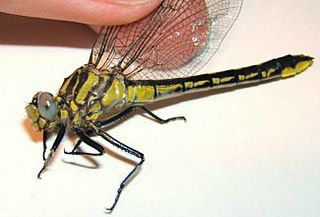
Teneral female Pronghorn Clubtail (Gomphus graslinellus)

Teneral female Pronghorn Clubtail (Gomphus graslinellus)
Off to Sherwood Park, a strange little township park used for fishing and off-road vehicles. It has a large pond surrounded by sandy two-tracks, fields, and woods. Stylurus snagged one of these snoozers, a female Dusky Clubtail, a dull species we found here last year.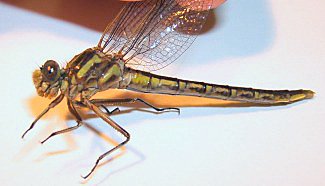
Teneral female Dusky Clubtail (Gomphus spicatus)
Don't be impressed -- I can't recognize these in the field, or even in the hand. I had to suffer over some keys back at home. Female Gomphus all have quite different vulvar lamina (the structures under the 9th abdominal segment that hold eggs in place during ovipositing), and G. spicatus has a very distinctive convex, almost tri-lobed occiput, shown in the photo below.
Occiput of G. spicatus
Last, and least in size but not in importance, I netted a very teneral female gomphid that was smaller than the other two. By the time I got it home, it had "deflated." Nonetheless, the vulvar lamina and occiput were still distinguishable. That and the very small size (hindwing 25 mm and abdomen only 30 mm) helped me identify it as a Lancet Clubtail (G. exilis), a new county record, our 40th for Wayne Co. (although two are sight records), bringing the county checklist up to 90 species.
Not much else flying. The ubiquitous Eastern Forktail (Ischnura verticalis), a few Common Whitetails (Libellula lydia), and one teneral Calico Pennant (Celithemis elisa). The day quickly turned windy and cloudy, ending our adventures. But the official season seems off to a good start!
Subscribe to:
Posts (Atom)