29 May 2005

Lancet Clubtail


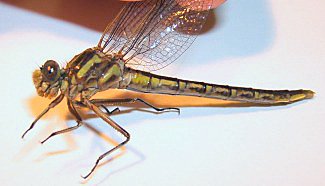
Teneral female Lancet Clubtail (Gomphus exilis)

Another stab at a decent voucher for Lancet Clubtail today at Sherwood Park. Of course, by the time I got off work and we got out there, the sunny, calm day had turned cloudy, windy, and threatened rain. This was the only dragonfly I saw, as we were walking back to the car, but it was the sought-after species, the dainty little Lancet Clubtail.


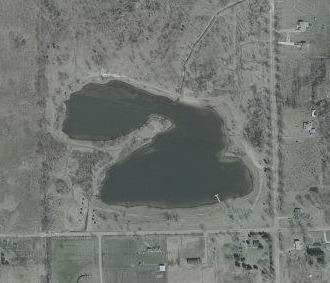
Sherwood Park, Sumpter Twp., Wayne Co., MI (northwest corner of Sherwood & Wear roads)

28 May 2005

I hate female gomphids! But love new records

Finally, it's been sort of warm for a few days -- something must be emerging! Stylurus and I went to some of our favorite sandy ponds to look for those annoying early gompids. First stop, Oakwoods Metropark. We've had some very good gomphids here, including the state's first record of Flag-tailed Spinyleg (Dromogomphus spoliatus), although we were unable to voucher the first record. Stylurus decided he needed to stand around in the woods to listen for Acadian Flycatchers, so I kicked around in the weeds near a pond. Only a few glistening-winged teneral odes flew up, but I snagged this one, a female Pronghorn Clubtail. In 2003, we vouchered the first county record of this species at the same location.
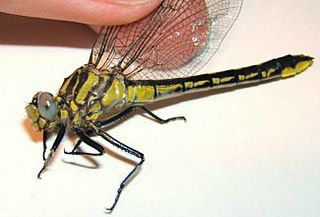
Teneral female Pronghorn Clubtail (Gomphus graslinellus)

Off to Sherwood Park, a strange little township park used for fishing and off-road vehicles. It has a large pond surrounded by sandy two-tracks, fields, and woods. Stylurus snagged one of these snoozers, a female Dusky Clubtail, a dull species we found here last year.
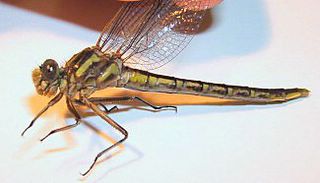
Teneral female Dusky Clubtail (Gomphus spicatus)

Don't be impressed -- I can't recognize these in the field, or even in the hand. I had to suffer over some keys back at home. Female Gomphus all have quite different vulvar lamina (the structures under the 9th abdominal segment that hold eggs in place during ovipositing), and G. spicatus has a very distinctive convex, almost tri-lobed occiput, shown in the photo below.
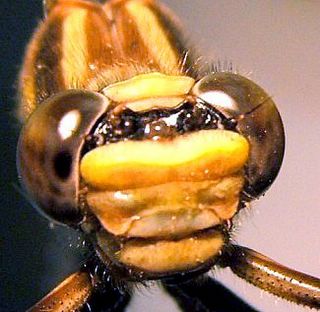
Occiput of G. spicatus

Last, and least in size but not in importance, I netted a very teneral female gomphid that was smaller than the other two. By the time I got it home, it had "deflated." Nonetheless, the vulvar lamina and occiput were still distinguishable. That and the very small size (hindwing 25 mm and abdomen only 30 mm) helped me identify it as a Lancet Clubtail (G. exilis), a new county record, our 40th for Wayne Co. (although two are sight records), bringing the county checklist up to 90 species.

Not much else flying. The ubiquitous Eastern Forktail (Ischnura verticalis), a few Common Whitetails (Libellula lydia), and one teneral Calico Pennant (Celithemis elisa). The day quickly turned windy and cloudy, ending our adventures. But the official season seems off to a good start!

21 April 2005

A bee fly of my own


Bombylius major -- "...the hairy and handsome harbingers of spring." --Frank R. Cole

I've finally gotten a half-way decent photo of a Bombylius bee fly; this is probably B. major, a common and widespread (as in much of the Northern Hemisphere) species.

As adults, Bombylius feed on nectar by hovering over early spring flowers. The larvae are parasites in the nests of solitary bees, feeding on the food stores and larvae of the hosts. Thus, the adults must find the burrows of solitary bees before they are sealed up, and lay their eggs in them. It would seem most straightforward if Ms. Bombylius just went directly into the nest burrow, but I suppose that the hosts have all sorts of defenses against such an intrusion. Instead, the female Bombylius hovers over the hole and flicks her eggs inside. Wow. I've watched them searching for burrows, investigating what I presume must be likely-looking (from a bee fly's point of view) holes, the forceful breeze from their wings tossing and scattering grains of soil as if a tiny tornado was attacking a square-inch patch of ground. But so far, I've not seen the old ovum toss. I'll keep looking; I'm a bit taken by these insects. Stylurus says they look like little plush toys. It's a compliment not paid to many flies, I'm sure.

Here's a nice article on bee flies, featured as "Bug of the Month", where I found the Frank Cole quote above.

15 April 2005

The Friday Ark

The entry below is included in today's The Friday Ark by the Modulator, a carnival of photos that spans many taxa. Enjoy!

14 April 2005

While we wait for odonata


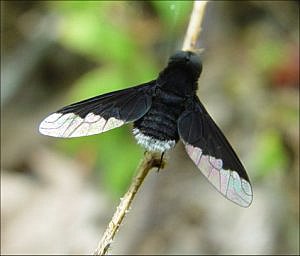
A bee fly. Not Hemipenthes sinuosa but perhaps Anthrax analis

The darner the other day is still the only ode I've seen so far this season. So I'll take this opportunity to post this excellent shot of a bee fly my friend Dr. Steve took last summer here in Michigan. Diptera are multitudinous, and I am, after all, an ornithologist, so I had no idea how to identify this one. But my particular jones is that I have to name and/or count just about all living creatures I encounter (a curse I'll have to write about one day). It wasn't until I was trying to identify another type of fly now buzzing about my study plot that I finally came across a photo that finally allowed me to pin a name on Steve's bug (to my great relief). I am fairly certain of the species, and even more confident of the genus. Comments from more knowledgeable dipterologists are welcome!

UPDATE: After contemplating this fly, with it's white-tipped abdomen, I decided I had been smug too soon. This was confirmed by Giff Beaton, ode guru of Georgia (who has a great page on bee flies), who wrote to me:

"I think it's very likely to be Hemipenthes, but I don't think it's sinuosa. That is a pretty common species here, and I have never seen one with a white-tipped abdomen. Definitely not Ogdocera, either..."

Among Michigan Bombyliidae, I've now settled upon Anthrax analis based upon this one lonely photo.