02 February 2006

Some tropical lepidoptera


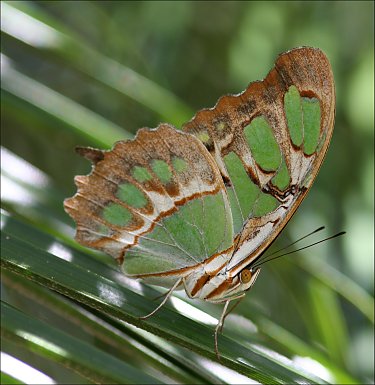
The Malachite (Siproeta stelenes) is a classic butterfly of the tropics, found from south Florida and south Texas through Brazil. With a 9 cm wingspan, and brilliant green coloration, it's hard to miss. The upperside is kelly green and black, in a pattern reminiscent of a swallowtail. I kind of prefer the more subtle patterning on the underside of the wings.

Adults feed mostly on rotting fruit, sometimes nectar and dung, and are found along forest edges and openings, including disturbed areas. Among the larval host plants is ruelli
a and shrimp plant (Blechum brownei). The latter, a non-native ornamental considered an invasive weed, has probably helped this butterfly spread in the southern U.S., or at least Florida, after the insect arrived, presumably from Cuba, sometime in the 1960s. La Belen Preserve, Najasa, Camaguey Province, Cuba.

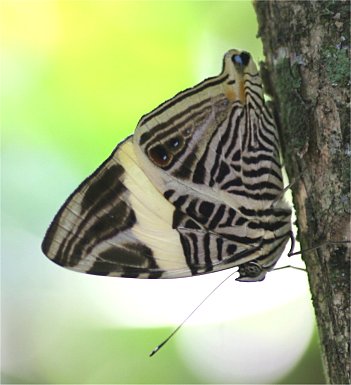
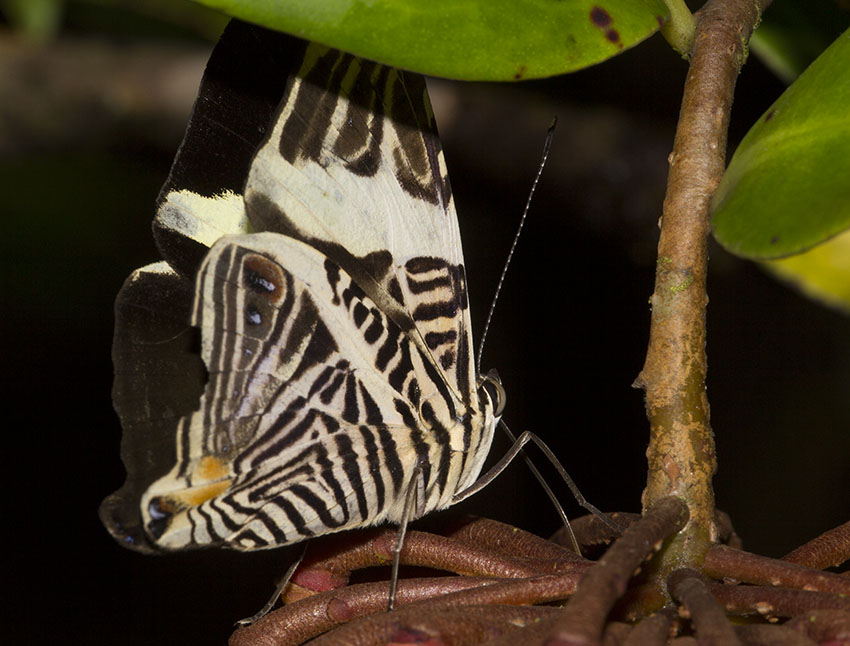
Colobura dirce, sometimes called The Mosiac, is seen here in its characteristic head-down pose, which it strikes after an erratic pell-mell flight through shady forests throughout the Greater Antilles and Mexico south to Argentina. Larva feed on Cecropia, a familiar tropical pioneer tree species. Colobura is much cooler looking in this posture; the uppersides of the wings are plain brown with a cream-colored stripe. Rio Hatiguanico, Zapata Swamp, Matanzas Province, Cuba.

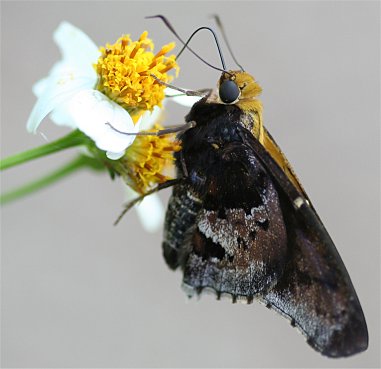
The Mercurial Skipper (Proteides mercurius) is a large skipper with a gorgeous subtle pattern on the underwings, and a glowing orange head and body. It would seem to be hard to miss, but is reported to be secretive. It can be found in the southern U.S. and the Greater Antilles. This particular subspecies, P. m. sanantonio, is endemic to Cuba. Palpite, Matanzas Province, Cuba.


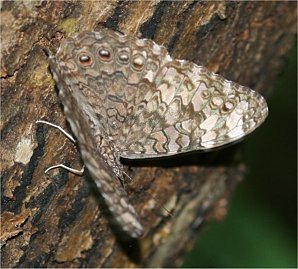
The Pale Cracker (Hamadryas amphichloe) is in a family named so because the wings can make an audible "clicking" sound. This species, found from Mexico to Peru and on the larger West Indian islands, may be silent. Sierra Cubitas mountains, Camaguey Province, Cuba.

05 January 2006

Bias in butterfly monitoring

I read an interesting paper in the journal Biological Conservation regarding bias involved in detecting various species of butterflies in standardized monitoring schemes. This bias, of course, can lead to misleading comparisons of populations of different species. The study, which took place in Great Britain, found several biases.
  • The larger and more apparent butterfly species are, and the longer flight periods and wider distributions they have, the earlier is their first discovery date.
  • Abundance measures on the national project Butterflies for the New Millennium are higher for larger butterflies and lower for butterflies that are active on higher vegetation substrates (versus, say, ones that fly closer to the ground). Distribution on this project is positively correlated with visual apparency (ease of detection).
  • The Butterfly Monitoring Scheme uses transect data to track changes in annual abundances. Abundance increases with dorsal basking postures (open versus closed wings) and use of lower vegetation substrates.
These biases don't really affect the ability to assess changes in a single species, but make a difference if comparing populations of different species, and importantly points out that we need to understand the limitations of various survey schemes and their data sets. Some of these same types of bias are no doubt applicable to odonata, birds, and other taxa as well.

Dennis, R.L.H., T.G. Shreeve, N.J.B. Isaac, D.B. Roy, P.B. Hardy, R. Fox and J. Asher. 2006. The effects of visual apparency on bias in butterfly recording and monitoring. Biological Conservation 128:486-492.


02 December 2005

The next big thing

Good optics and great field guides helped make birding a hugely successful hobby (serious birders would find another word, I'm sure). Close-focus optics and field guides more suitable to identifying free-flying butterflies, rather than pinned specimens, boosted the popularity of seeking out these insects. The lastest beneficiaries of these tools has been dragonflies, which might be why you're here. The next bug folks might be looking for, photographing, listing, and posting about might be beetles. As one of the most abundant taxa on earth, we might be counting these things for a long time.


We found this Harlequin Flower Beetle (Gymnetis caseyi) in Texas slurping up some fermented slop that had been slapped out to attract sap-seeking butterflies. Those fine lines on the wing covers (elytra) are scratches, like gouges in the paint job of a Volkswagen.

One guy who is already thinking "beetle" is Mike Quinn of Texas Parks & Wildlife, who set up the Texas Beetle Information page, where you can see much nicer photos of the Harlequin Flower Beetle with references and other info.

29 November 2005

Hot times in the LRGV

Stylurus and I have made more than one holiday trip to the Lower Rio Grande Valley of Texas to enjoy the birds, butterflies, and dragonflies. Even in late fall and winter, you never know what you might find there, and often there are rarities of all these taxa.

Of course, the weather is always better there than here, and this weekend was no exception. We left Michigan in a howling snowstorm with the temps about 15 degree F. The Valley was sunny and hot, hotter than any of our previous November visits. That meant ponds, ditches, and the Rio Grande were buzzing with odonata!

We looked for odonata at several locations, primarily Santa Ana National Wildlife Refuge (SANWR), Bentsen-Rio Grande Valley State Park/World Birding Center, Edinburg Scenic Wetlands, and along the Rio Grande at Salineno. We ended up with over two dozen species, which is quite respectable for this time of year:

American Rubyspot (Hetaerina americana)
Common Spreadwing (Lestes disjunctus)
We are still examining some photos of another female Lestes
Blue-fronted Dancer (Argia apicaulis)
Blue-ringed Dancer (A. sedula) – According to both Abbott's great book, Dragonflies and Damselflies of Texas and the South-Central States, and his web site, Odonata Central, a late date for the region. We had at least a half dozen along the irrigation canal at Bentsen.
Dusky Dancer (A. translata)
Double-striped Bluet (Enallagma basidens) -- One male along the irrigation canal at Bentsen; late date.
Familiar Bluet (E. civile)
Neotropical Bluet (E. novaehipaniae) -- A lifer for us. I picked it out of a spider web at Salineno so I was able to confirm the ID later.
Rambur’s Forktail (Ischnura ramburii) – We photographed one interesting blue-thoraxed male along the irrigation canal at Bentsen.
Caribbean Yellowface (Neoerythromma cultellatum) - A lifer, a pair in tandem along the irrigation canal at Bentsen; late date. These were super-cool. Wish we could have gotten a photo (without falling in the canal).
Desert Firetail (Telebasis salva)
Common Green Darner (Anax junius)
Black Setwing (Dythemis nigrescens) -- Quite common, handsome little guys like the one pictured above.
Pin-tailed Pondhawk (Erythemis plebeja) – One male at the ponds near the front entrance of SANWR; late date by over a month.
Eastern Pondhawk (Erythemis simplicollis)

Straw-colored Slyph (Macrothemis inacuta) -- A lifer for us, seen two days in a row at the very dry, waterless old manager's residence at SANWR. Also late by over a month. It finally posed for a photo, above.
Spot-tailed Dasher (Micrathyria aequalis) –Also quite late.
Thornbush Dasher (Micrathyria hageni)
Roseate Skimmer (Orthemis ferruginea)
Blue Dasher (Pachydiplax longipennis)
Wandering Glider (Pantala flavescens)
Eastern Amberwing (Perithemis tenera) – One female along irrigation canal at Bentsen was also a little late.
Filigree Skimmer (Pseudoleon superbus) – This stunning ode was not a lifer, as we had seen one at SANWR two years ago. Theoretically, there really isn't great breeding habitat (noted as desert ponds and slow streams) in the vicinity for them, and they are thought to be vagrants. This time, we saw four individuals at SANWR, none of which were near water. The female below was also at the old manager's residence, where we had nine different odonata species! Abbott lists no dates past late August.
Variegated Meadowhawk (Sympetrum corruptum)
Black Saddlebags (Tramea lacerata)
Red Saddlebags
(T. onusta)

Many of these late dates mostly reflect the lack of work in the Valley at this time of year. With the addition of Josh Rose on the staff of the World Birding Center, this should change. Josh is great with birds, getting a crash course in rare Texas butterflies, has a keen interest in beetles and other insects, and is a very enthusiastic odonatist, having worked on them for his PhD. He is leading regular dragonfly walks at Bentsen, and is sure to find many more interesting odes in the months to come. He's not only knowledgeable, but friendly and generous with his time. Thanks for your help, Josh!

13 November 2005

Nice knockers!

At a museum shop today, Stylurus and I saw some cool dragonfly merchandise. What we liked the most was this really nice doorbell. Unfortunately, it won't fit where our current doorbell is placed. I'm not even sure our doorbell works!


Then there were these door knockers. The one of the left was nice, I didn't care for the shiny one on the right. The little dragonfly on the bottom is also a doorbell.

I like our current door knocker, which I got on eBay. Yeah, I know our door needs painting.