LOCATIONS VISITED
FINCA ESPERANZA VERDE (FEV) -- shade coffee farm near San Ramon, Matagalpa dept.
-- Main buildings: 12.93978, -85.78003, 1100 m
-- Yellow trail creek: 12.93398, -85.78248, 1100 m
-- Blue trail creek: 12.9382, -85.7814
"GENERAL NESTOR'S" (GN) -- private property near El Naranjo, Matagalpa dept.; 12.89714, -85.78798, 688 m
SELVA NEGRA -- shade coffee and forest reserve between Matagalpa and Jinotega, Matagalpa dept.; 13.00024, -85.90874, 1290 m
DOMITILA -- private reserve of dry tropical forest near Nandaime, Granada dept.
-- Main buildings: 11.708642, -85.953549
-- Rio Hacienda (southern stream; referred to as "Rio Dorado" by Fred Sibley in his Argia article summarizing his August 2003 visit): 11.7013, -85.9522
-- Rio Pintal (northern stream): 11.7097, -85.9558
 Hetaerina caja (keyed out using microscope); Rio Hacienda, Domitila,
14 March 2009, fairly common.
 Hetaerina cruentata. One at FEV on 5 March; several also seen at
Selva Negra on 11 March 2009.

 Racket-tipped Rubyspot (Hetaerina occisa). Seen first (several)
at GN on 9 March, males easy to diagnose in hand;
a few at Rio Hacienda, Domitila, 14 March 2009.

 Archilestes grandis.
 GN on 9 March 2009.
 Lemon-tipped Helicopter Damsel (Mecistogaster ornatus).
Rio Hacienda, Domitila, 14 March 2009.
 Amelia's Threadtail (Neoneura amelia), Domitila, 12 March 2009. These
were found on both streams, both males and pairs and ovipositing, but
were easy to overlook. I included the inset because I thought the pose
looked rakish.


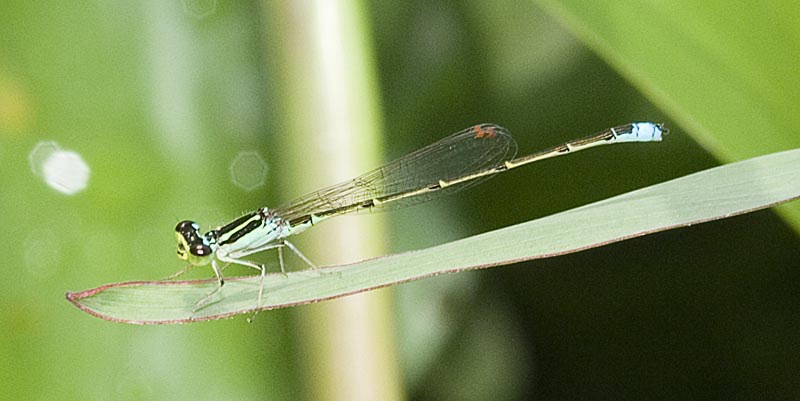
 This individual in the first three photos keyed out to
Anisagrion allopterum. Blue trail, FEV, 8 March 2009. The last photo
was one seen at Selva Negra on 11 March, which Dennis Paulson also
identified as this species.

 These were common at FEV (top one on the yellow trail on 5 Mar, bottom
on blue trail on 9 Mar). Cerulean Dancer (Argia anceps) looks similar to
A. fissa and A. westfalli, but those species are apparently not found there,
and the claspers were hairy and flattish, so anceps is as close as we get.

 We saw only one of these robust females ovipositing in a muddy stream
on wet leaves or mud along the blue trail at FEV. She was tan with metallic
green darker areas; slightly flavescent wings with tan pseudostigma;
s9 and s10 pale; ovipositor extended well beyond tip of abdomen and was
pale with a narrow black rim. This also points to A. anceps; 7 March 2009.

 Spine-tipped Dancer, Argia extranea; a nearly identical individual
we photographed in Panama was identified as such by Dennis Paulson.


 Paulson also thinks this is a dark A. extranea. Around our cabin at FEV, 4 March 2009.
 Bluepoint Dancer, Argia oculata, part of variable species complex.
Head and abdomen shots. GN, 9 March 2009.


 Fiery-eyed Dancer (Argia oenea). First found, including pairs in tandem
and ovipositing, at GN, 9 March. Also found at most stream crossings at
Domitila, 12-14 March 2009.
 We saw surprisingly few dark-colored Argia. This appears to be
Dusky Dancer, Argia translata, although the pattern on the tip of
the abdomen is not an exact match (I understand they are quite variable).
At a pool on Rio Pintal at Domitila, 12 March 2009.
 Caribbean Yellowface (Neoerythromma cultellatum). Pestering all other
damsels at Rio Hacienda, Domitila, 14 March 2009.
 This gorgeous Turquoise-tipped Darner (Rhionaeschna psilus) was
buzzing around our cabin at FEV, 8 March 2009.
 Bar-sided Darner (Gynacantha mexicana), in the Hotel Alhambra
hallway, Granada, 11 March 2009.
 We saw plenty of Brown Setwings (Dythemis sterilis) at Domitila. They
seemed obvious in the field, but not in the hand. 12 March 2009.
 It took forever to catch this Red Pondhawk (Erythemis
haematogastra). Rio Hacienda, Domitila, 14 March 2009.
 Pin-tailed Pondhawk (Erythemis plebja), Domitila, 12 March 2009.
 Black-winged Dragonlet (Erythrodiplax funerea). The bottom photo
is an immature which looks like a Band-winged Dragonlet, E. umbrata.
However, note the uneven width of the wing bands,with the
hindwing band broader than the forewing (nice tip from Paulson).
Domitila, 13 March 2009.
 We did have Band-winged Dragonlet (Erythrodiplax umbrata), too.
Also near Rio Pintal, Domitila, 12 March 2009.
 Hard to believe this is the same species we saw in 2005
in Panama. Wide-tailed Sylph (Macrothemis pseudimitans),
GN, 9 March 2009.
 Hyacinth Glider (Miathyria marcella), with a thorax that
seems sort of heavily patterned. Domitila, 12 March 2009.
 There were far fewer dashers than expected. This was one of a few
Spot-tailed Dashers (Micrathyria aequalis) found on Rio Pintal within a
couple of kilometers of Lake Nicaragua, Domitila 13 March 2009.
 Roseate Skimmer (Orthemis ferruginea); common at Domitila,
12-14 March 2009.
 Female Orthemis levis, Domitila, 13 March 2009.

 This female Orthemis was perhaps one of our most interesting odes of the trip.
The thorax isn't quite as patterned as O. ferruginea. Paulson first identified it
as Orthemis schmidti (also here) which has not been recorded for Nicaragua. Later,
he thought it must be a heavily-patterned Orthemis discolor.
Along a dusty road near a goat pen, GN, 9 March 2009.
 Female Red Rock Skimmer (Paltothemis lineatipes). This one had us
stumped for awhile. Around our cabin at FEV, 4 March 2009.
 Striped Saddlebags (Tramea calverti) was abundant in swarms at
Domitila. 12 March 2009.
Species seen at FEV:
Species seen at "General Nestor's":
- Hetaerina cruentata
- Anisagrion allopterum
- Cerulean Dancer (Argia anceps)
- Spine-tipped Dancer (Argia extranea)
- Turquoise-tipped Darner (Aeshna psilus)
- Great Pondhawk (Erythemis vesiculosa)
- Red Rock Skimmer (Paltothemis lineatipes)
Species seen at "General Nestor's":
- Racket-tipped Rubyspot (Hetaerina occisa)
- Archilestes grandis
- Bluepoint Dancer (Argia occulata)
- Fiery-eyed Dancer (Argia oenea)
- Amazon Darner (Anax amazili)
- Wide-tailed Sylph (Macrothemis pseudimitans)
- Orthemis discolor
- Pallid Amberwing (Perithemis mooma)
- Hetaerina caja
- Racket-tipped Rubyspot (Hetaerina occisa)
- Lemon-tipped Helicopter Damsel (Mecistogaster ornata)
- Amelia's Threadtail (Neoneura amelia)
- Orange-striped Threadtail (Protoneura cara)
- Fiery-eyed Dancer (Argia oenea)
- Dusky Dancer (Argia translata)
- Caribbean Yellowface (Neoerythromma cultellatum)
- Brechmorhoga vivax
- Brown Setwing (Dythemis sterilis)
- Red Pondhawk (Erythemis haematogastra)
- Pin-tailed Pondhawk (Erythemis plebeja)
- Great Pondhawk (Erythemis vesiculosa)
- Black-winged Dragonlet (Erythrodiplax funerea)
- Band-winged Dragonlet (Erythrodiplax umbrata)
- Hyacinth Glider (Miathyria marcella)
- Miathyria simplex -- new for Nicaragua!
- Spot-tailed Dasher (Micrathyria aequalis)
- Roseate Skimmer (Orthemis ferruginea)
- Orthemis levis
- Wandering Glider (Pantala flavescens)
- Striped Saddlebags (Tramea calverti)