27 October 2008

An honor for a friend

As some of you know, or have gathered, I'm an ornithologist by profession; Stylurus is an engineer. Our interests in other taxa are varied, but our passion for Odonata was supported and stoked by one person, Mark O'Brien, collections manager of insects at the University of Michigan Museum of Zoology and head honcho of the Michigan Odonata Survey. Yes, it's all his fault.

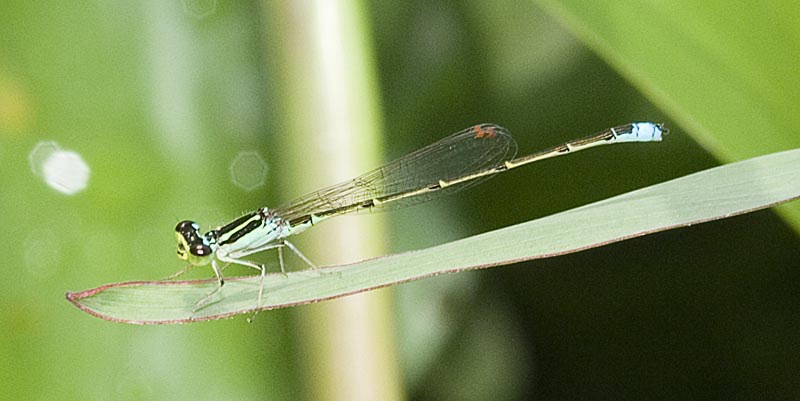
He recently received one of the coolest honors that anybody can get, and one that is especially super-cool for those of us who are really into natural history and taxonomy: he had a species named after him. It is a tropical damselfly, Homeoura obrieni, described by Natalia von Ellenreider. Maybe Mark would have preferred a wasp, since that was his taxa of academic expertise, but it seems like he's thoroughly adopted odes, and I know he's pleased.

I waded through the paper to learn a little more about Mark's namesake. It describes the history of the genus Homeoura as "complex and tortuous," with the species currently ascribed to it as belonging to a number of other genera in the pond damsel family Coenagrionidae at one point or another over the last 90 years. von Ellenreider works it all out, putting two former Homeoura species in another genus, keeping three species, transferring a forktail (Ischnura) to Homeoura, and describing H. obrieni. The 26-page paper includes lots of illustrations and keys.

The genus Homeoura consists of small, mostly black damsels with pale blue or yellow areas. H. obrieni is not newly discovered in the just-collected sense, but is described from older museum specimens. Specimens of H. obrieni were previously misidentified as Argentagrion lindneri, A. nepos, and H. nepos. This species is found in lentic habitats in Brazil, Colombia, and Venezuela. The photo above doesn't reveal much. I found a few photos of H. nepos (which may or may not be that species, or H. obrieni), and can tell you that these do indeed look like little forktails. Much like our familiar Eastern Forktail, but with Citrine Forktail-like red stigma. Here's a dull, dried out pair of H. nepos specimens from Dennis Paulson, a male from Tom Davis from Brazil, and a female from Arvind Bhateja.

von Ellenreider states the etymology: "Named after my colleague Mark O'Brien, in gratitude for his manifold assistance to students interested in the rich dragonfly collection at the UMMZ."

Indeed, Mark is deserving of recognition for fostering Odonata love far and wide. Not only did he encourage the Urban Dragon Hunters into being, but he and his wife have also become two of our most fun and valued friends. Congrats, Mark, on this honor, and thanks for all your support and friendship!

von Ellenreider, N. 2008. Revalidation of Argentagrion and redefinition of Homeoura, with the description of H. obrieni n. sp. (Odonata: Coenagrionidae). Rev. Soc. Entomol. Argent.67: 81-106.

19 October 2008

End of the 2008 flight season in Michigan

It's disappointing to reach the end of the 2008 flight season for dragonflies in Michigan. I was hoping to get out and look for some late odes this weekend, but head colds and other activities took priority.

There still are a couple of common species that can be found over the next couple of weeks, but I don't expect to find anything new or startling.

Last Sunday (October 12), Nannothemis and I did find new late dates for the state. We visited the Humbug Marsh unit of the Detroit River International Wildlife Refuge again.
1. several Tule Bluets (Enallagma carunculatum)
2. one male Familiar Bluet (Enallagma civile), we have sighted one as late as October 15th in a previous year
3. one female Ruby Meadowhawk (Sympetrum rubicundulum)

Other late fliers were a couple of darners (Aeshna sp.), but I couldn't make an ID to species and one male Black Saddlebags (Tramea lacerata).

Following is what may be my last Michigan dragonfly photo of the year from the field...
a female Common Green Darner (Anax junius)


... of course, this may be the first Michigan species to photograph in 2009.

28 September 2008

Unexpected Darner

On Saturday, 9/27, I made a late afternoon trip over to Lenawee County to search for a couple of late season darners (Aeshna sp.) that would be new for the county. Onsted State Game Area near Cambridge Junction seemed like a good location since it includes several lakes and the River Raisin.

I initially stopped at the boat launch on the east shore of Grassy Lake and immediately saw a darner flying over the water. A 2nd one flew over my head and with a quick swing of the net, I found myself with an unusual male darner. The claspers were not wedge-shaped, but were fairly straight and there was a bump on the dorsal surface of abdominal segment 10. I initially thought of Canada Darner (Aeshna canadensis), that is, until I looked at the thorax. The mottled pattern clearly was that of a Mottled Darner (Aeshna clepsydra). A new species for me and the first for the county.

Searches of the adjacent lakes including One Mile Lake and Cleveland Lake didn't turn up any other darners so I returned to the original location for another hour.

There were ~4 males patrolling the shoreline and methodically searching the vegetation, just inches above the water of Grassy Lake.

At one point, one individual was checking me out, flying around me, checking out my face, then actually landing on my hat. I found this species to be very unwary and actually had a couple more instances of individuals fly near/around me while checking for prey.

Periodically individuals would land on tree trunks and, luckily, allowed a close approach.

Another darner landed in a dead tree, almost beyond the reach of my net. However, there were branches in the way so I fished my net up to the trunk. Surprisingly, the darner didn't fly and I was able to slowly position my net next to this dragonfly and get it to move onto the hoop. I was able to move the net out from the branches, and capture it with a quick flick of the wrist.

Surprise, another Mottled Darner (A. clepsydra).

Here's a closeup of the thoracic pattern.

...and the claspers

25 September 2008

Dragonflies of September

I both like and dislike September for odes. This month includes the last weeks of most dragonflies in southeast Michigan, but it includes the peak of some of my favorites such hanging clubtails (Stylurus sp.) and mosaic darners (Aeshna sp.).

While searching for Monarchs as noted in the previous post, I was also keeping an eye out for late season insects.

Knowing that we didn't have a good late date for Russet-tipped Clubtail (Stylurus plagiatus), I headed for the most reliable location in the refuge for this species. Almost immediately a female flew up from a waist-high dogwood and landed a few meters away. This individual extended the late date for Michigan by more than 2 weeks.

Several minutes later I found this 2nd female about 40m away. Thus, she is technically the late date S. plagiatus.

While wandering the fields of Tall Boneset looking for butterflies, this pair of Shadow Darners (Aeshna umbrosa) would repeatedly fly by, perch, then fly around a bit more and land again. For more than 30-40 minutes this pair was in the wheel.


At one point a male clubtail (Stylurus sp.) landed high up in a tree which was not a Russet-tipped. In past years, I've thought I may have seen Arrow Clubtails (S. spiniceps), but once again this individual was not in a position to make an ID. Thus, this species is still unconfirmed for this site.

While checking nearby trees, I did find a female clubtail which turned out to be an Elusive Clubtail (S. notatus). This was the 3rd or 4th time to see one in this area and only one of a couple dozen sightings for MI.

...and here's a closeup

22 September 2008

Smoky Rubyspot: New county record

One of our tasks this summer was to tag Monarch butterflies at the Detroit River International Wildlife Refuge, mostly the Humbug unit but other Detroit River habitats. Since Point Pelee is such an important migratory stopover for Monarchs, we thought this would be a worthwhile project for the U.S. side of the river. As luck would have it, this has been a spectacularly dismal year for Monarchs. We optimistically ordered two hundred tags, but have only tagged TWO butterflies so far!

Our consolation prize was found at Humbug on Saturday. Stylurus caught this old female damselfly. At first, we weren't sure what it was, although the little white pseudostigma pointed to a broad-winged damsel (Calopterygidae).

It was too dull and narrow-winged to be a jewelwing, leaving us with a rubyspot. We came to the conclusion it was a Smoky Rubyspot, Hetaerina titia, a species with only about 7 other state records, none for our county. I gave it a careful exam, since this is a species we had little experience with. Her thoracic pattern matched, her legs were dark, as was her ovipositor. These characteristics help separate it from the much more common American Rubyspot, H. americana. And the clincher is the spine on the dorsal surface of segment 10, shown in this shot.

Nice scans that help show these featuers can be found online: Smoky Rubyspot here, and American Rubyspot here.

Smoky seems to prefer larger rivers and streams than American. The similarity of the females of both species, and the later flight period of Smoky might indicate they are overlooked in Michigan, but this is probably fairly close to the northern limit of its range. Considering we have never recorded American Rubyspot at Humbug, or any location along the Detroit River, this Smoky Rubyspot was an unexpected find!