
11 May 2006
Lancet Clubtail kicks off for the season
I've only spent a tiny amount of time in the field, but really haven't seen squat yet. However, yesterday, Stylurus brought home a teneral female Lancet Clubtail, Gomphus exilis, from Oakland Co. This is the earliest record for an adult in the state by 9 days. This boring little ode (sorry, but they are really very dull) is one of the earliest odes to emerge in spring. We've had them before in Wayne County as well.
10 May 2006
Dragonfly migration, part 1
The British newspaper The Telegraph reports on a study published in Biology Letters, where migrating dragonflies were tracked in fall migration along the U.S. Atlantic coast using small transmitters and airplanes. Turns out odonata use similar cues and strategies as birds during migration. One green darner, nicknamed Dave, traveled 100 miles in a single day (Dave's route shown in this map from the Telegraph article. The paper abstract is below. VERY COOL!
Wikelski, M., D. Moskowitz, J. S. Adelman, J. Cochran, D. S. Wilcove, M. L. May. 2006. Simple rules guide dragonfly migration. Biology Letters (early online).
Dragonfly migration, part 2 will be awhile in coming, but I have started writing a post describing what we know about migration in odonata. The use of radio transmitters is obviously promising, but also, if one has to use planes, prohibitively expensive.
*58 km = 36 miles.Every year billions of butterflies, dragonflies, moths and other insects migrate across continents, and considerable progress has been made in understanding population-level migratory phenomena. However, little is known about destinations and strategies of individual insects. We attached miniaturized radio transmitters (ca 300mg) to the thoraxes of 14 individual dragonflies (common green darners, Anax junius) and followed them during their autumn migration for up to 12 days, using receiver-equipped Cessna airplanes and ground teams. Green darners exhibited distinct stopover and migration days. On average, they migrated every 2.9±0.3 days, and their average net advance was 58*±11km in 6.1±0.9 days (11.9±2.8kmd−1) in a generally southward direction (186±52°). They migrated exclusively during the daytime, when wind speeds were less than 25kmh−1, regardless of wind direction, but only after two nights of successively lower temperatures (decrease of 2.1±0.6°C in minimum temperature). The migratory patterns and apparent decision rules of green darners are strikingly similar to those proposed for songbirds, and may represent a general migration strategy for long-distance migration of organisms with high self-propelled flight speeds.

Wikelski, M., D. Moskowitz, J. S. Adelman, J. Cochran, D. S. Wilcove, M. L. May. 2006. Simple rules guide dragonfly migration. Biology Letters (early online).
Dragonfly migration, part 2 will be awhile in coming, but I have started writing a post describing what we know about migration in odonata. The use of radio transmitters is obviously promising, but also, if one has to use planes, prohibitively expensive.
02 May 2006
Odonata goals for 2006
Time to record for posterity and future reference the goals the Urban Dragon Hunters hope to accomplish this field season.
- Examine lots of Common Baskettails, Epitheca cynosura, to see if some aren't actually Stripe-winged Baskettails, Epitheca costalis. There are a few records of E. costalis for Michigan, as well as some cynosura/costalis intergrades. You can read about this interesting situation in a past issue of the Williamsonia (pdf).
- Does Southern Spreadwing (Lestes disjunctus australis) really occur in Wayne County? There are about a dozen specimens for the state, but none for Wayne Co., although there is an old published record. I've been looking for them, to no avail so far. Likewise Hagen's Bluet (Enallagma hageni). Could be that these records are in error.
- Search some more for Turquoise Bluet, Enallagma divagans. A fairly recent published record exists for the county. Same for Spatterdock Darner (Aeshna mutata) and Four-spotted Skimmer (Libellula quadrimaculata).
- There are records here for Canada Darner (Aeshna canadensis) and Mottled Darner (A. clepsydra), but they are from prior to 1880. Methinks they are no longer around these parts. A similar old record exists for Lilypad Clubtail (Arigomphus furcifer), but I think this might be findable.
- Variegated Meadowhawk (Sympetrum corruptum) is a vagrant, and I'm hopeful it'll show up in the county again soon.
- New species that the Hunters feel should be found in the county include Lilypad Forktail (Ischnura kellicotti), Spangled Skimmer, (Libellula cyanea), and Black-shouldered Spinyleg (Dromogomphus spinosus). For the most part, the new county records we've obtained have been species that we were not looking for and did not expect, so who knows what we'll find!
- Get better photos of Nannothemis and Stylurus for the sidebar!
02 February 2006
Some tropical lepidoptera
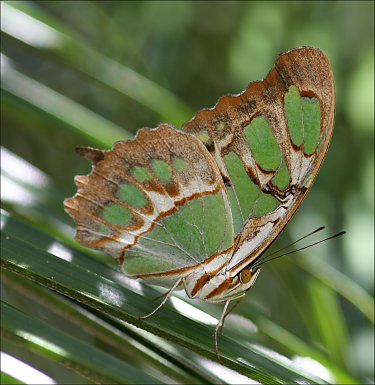
The Malachite (Siproeta stelenes) is a classic butterfly of the tropics, found from south Florida and south Texas through Brazil. With a 9 cm wingspan, and brilliant green coloration, it's hard to miss. The upperside is kelly green and black, in a pattern reminiscent of a swallowtail. I kind of prefer the more subtle patterning on the underside of the wings.
Adults feed mostly on rotting fruit, sometimes nectar and dung, and are found along forest edges and openings, including disturbed areas. Among the larval host plants is ruellia and shrimp plant (Blechum brownei). The latter, a non-native ornamental considered an invasive weed, has probably helped this butterfly spread in the southern U.S., or at least Florida, after the insect arrived, presumably from Cuba, sometime in the 1960s. La Belen Preserve, Najasa, Camaguey Province, Cuba.
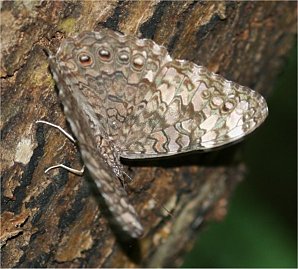
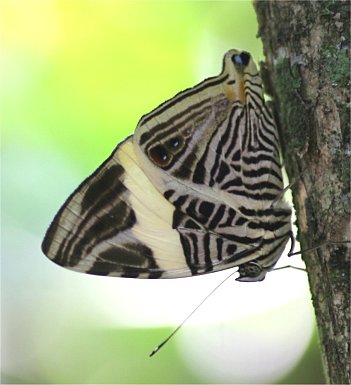 Colobura dirce, sometimes called The Mosiac, is seen here in its characteristic head-down pose, which it strikes after an erratic pell-mell flight through shady forests throughout the Greater Antilles and Mexico south to Argentina. Larva feed on Cecropia, a familiar tropical pioneer tree species. Colobura is much cooler looking in this posture; the uppersides of the wings are plain brown with a cream-colored stripe. Rio Hatiguanico, Zapata Swamp, Matanzas Province, Cuba.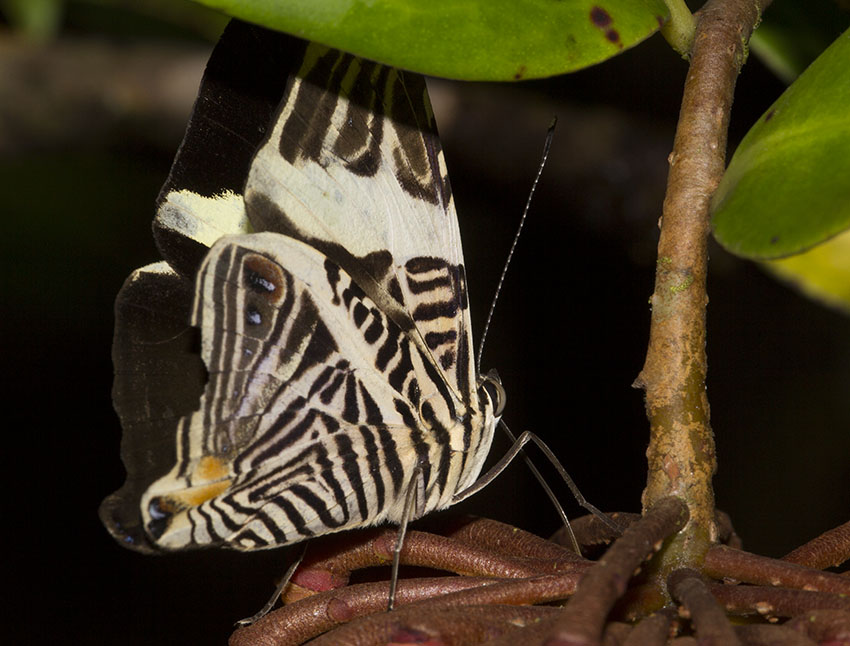
The Mercurial Skipper (Proteides mercurius) is a large skipper with a gorgeous subtle pattern on the underwings, and a glowing orange head and body. It would seem to be hard to miss, but is reported to be secretive. It can be found in the southern U.S. and the Greater Antilles. This particular subspecies, P. m. sanantonio, is endemic to Cuba. Palpite, Matanzas Province, Cuba.
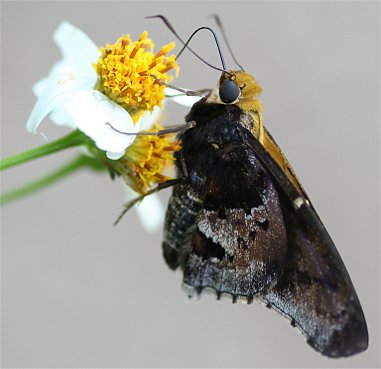
The Pale Cracker (Hamadryas amphichloe) is in a family named so because the wings can make an audible "clicking" sound. This species, found from Mexico to Peru and on the larger West Indian islands, may be silent. Sierra Cubitas mountains, Camaguey Province, Cuba.
05 January 2006
Bias in butterfly monitoring
I read an interesting paper in the journal Biological Conservation regarding bias involved in detecting various species of butterflies in standardized monitoring schemes. This bias, of course, can lead to misleading comparisons of populations of different species. The study, which took place in Great Britain, found several biases.
Dennis, R.L.H., T.G. Shreeve, N.J.B. Isaac, D.B. Roy, P.B. Hardy, R. Fox and J. Asher. 2006. The effects of visual apparency on bias in butterfly recording and monitoring. Biological Conservation 128:486-492.
butterflies
insects
- The larger and more apparent butterfly species are, and the longer flight periods and wider distributions they have, the earlier is their first discovery date.
- Abundance measures on the national project Butterflies for the New Millennium are higher for larger butterflies and lower for butterflies that are active on higher vegetation substrates (versus, say, ones that fly closer to the ground). Distribution on this project is positively correlated with visual apparency (ease of detection).
- The Butterfly Monitoring Scheme uses transect data to track changes in annual abundances. Abundance increases with dorsal basking postures (open versus closed wings) and use of lower vegetation substrates.
Dennis, R.L.H., T.G. Shreeve, N.J.B. Isaac, D.B. Roy, P.B. Hardy, R. Fox and J. Asher. 2006. The effects of visual apparency on bias in butterfly recording and monitoring. Biological Conservation 128:486-492.
butterflies
insects
Subscribe to:
Posts (Atom)