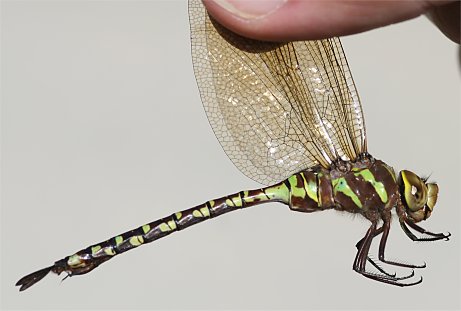
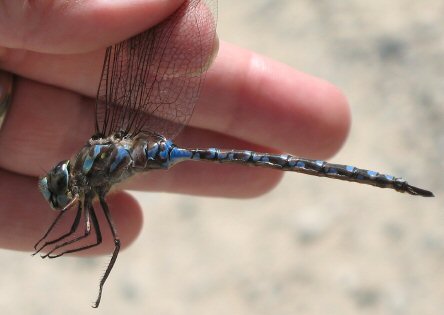
Once we got to the point along the southern edge of the brownfield where it was adjacent to the river, we started seeing Russet-tipped Clubtails. Stylurus, appropriately, found them first. We found at least two dozen prior to the rain starting again. Many were obligingly perched where they could be photographed:
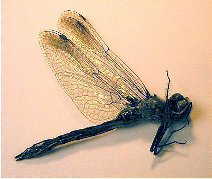
 We obtained two for voucher specimens, including a female with a deformed wing (below); I have a state endangered species permit which allows me to collect these species. I also collected a Tule Bluet (Enallagma carunculatum) with a deformed abdomen. Anybody who has spent enough time looking at odonata will find some funky ones. I've been thinking lately they are worthwhile to submit to museum collections, in case one day they can be examined for genetic defects or environmental contaminants, although I suppose most deformities are caused by some mishap during emergence. In this case, the Detroit River isn't particularly pristine, and there is a chemical plants just on the northern border...which was emitting strong paint fume odors even on this Sunday afternoon.
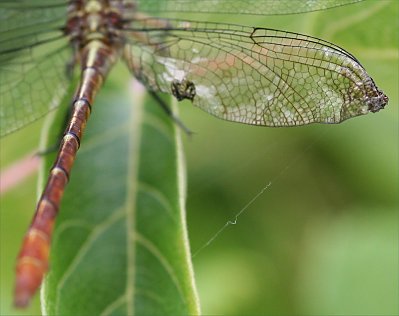 We also kicked up one or two other species of clubtails. One perched just out of net reach, and we were able to see it was indeed an Arrow Clubtail. Among the many Black Saddlebags and Common Green Darners were a handful of Aeshna darners; the ones we got looks at appeared to be Lance-tipped (A. constricta).
 I was poking around some shrubs and saw a red-colored saddlebags land on a twig. Carolina Saddlebags (T. carolina) are typically not common in southeast Michigan, although some years are good for them. We've seen very few this year.
This one, however, turned out to be a Red Saddlebags (T. onusta), a new county record. There are only two specimens for the state, and one photo record from the county. Pennsylvania just had its first state Red Saddlebags, so they may be on the move this year.
Note in the poor photos that the subgenital plates of this female specimen (b) are as long as segment 9 (a). Also, the red coloration does not fill the anal loop of the hindwing, as it does in the Carolina Saddlebags. I've outlined part of the anal loop (like a drunk) in green in these photos. Red on top, Carolina on bottom.
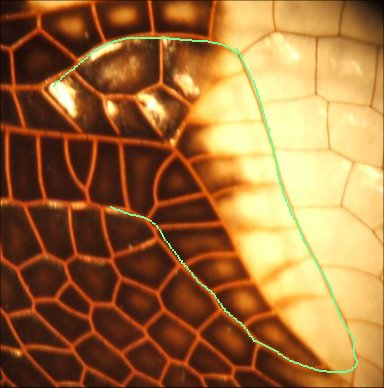
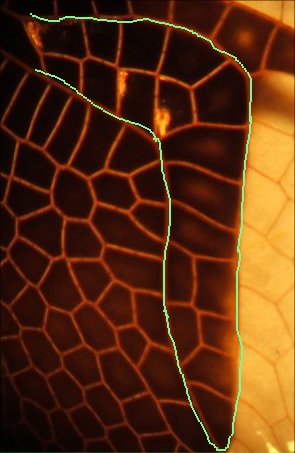 In addition to Red Saddlebags and Striped Saddlebags, other interesting vagrants lately have been Band-winged Dragonlet (Erythrodiplax umbrata) on 11 August in Cincinnati, Ohio and Evening Skimmer (Tholymis citrina) in ~19 Aug in McCurtain Co., Oklahoma. We'll be out again next weekend!